
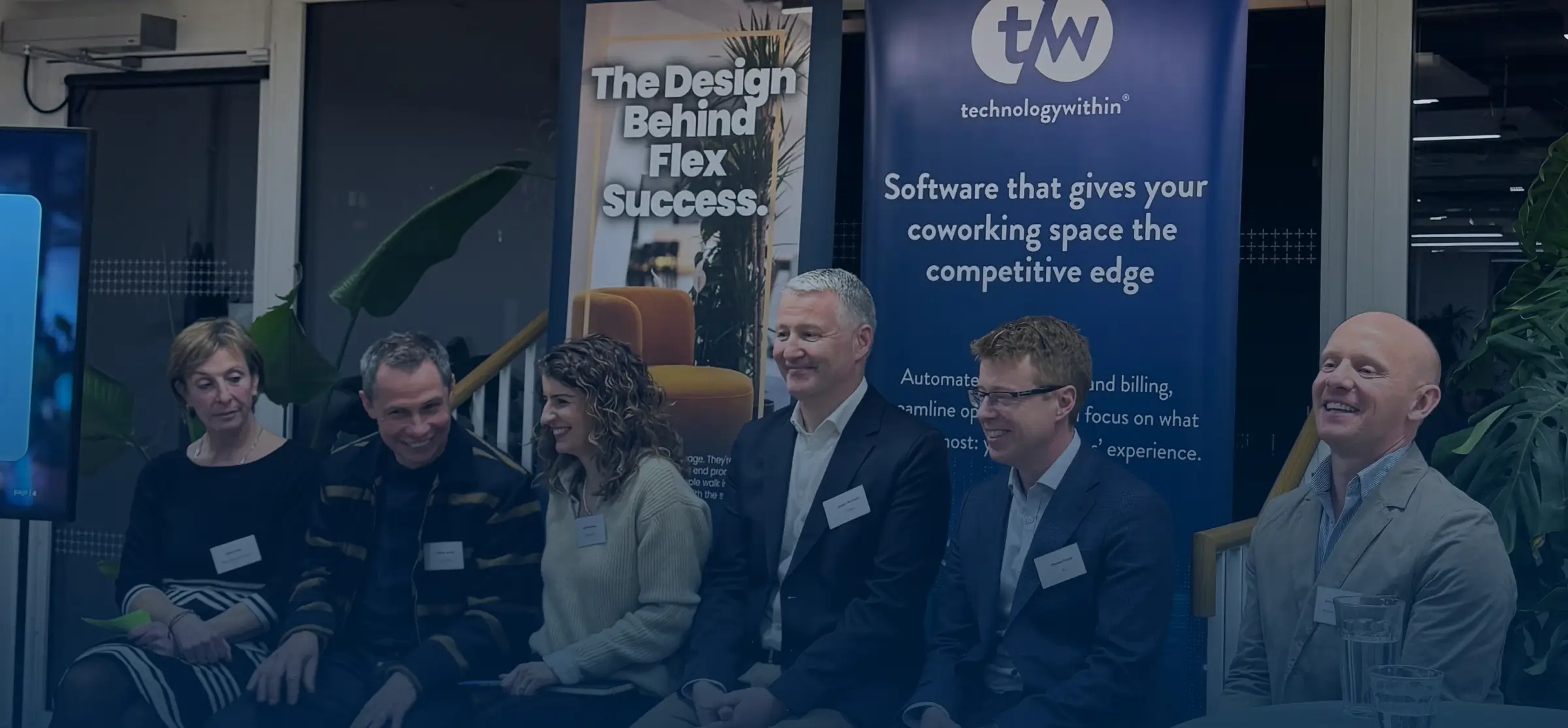

That message came through loud and clear at BE News Spotlight on Flex, an event proudly sponsored by technologywithin, alongside JLL and Interaction Ltd, and hosted at x+why.
Across the keynote and panel discussion, one theme kept resurfacing: the next chapter of flex will be defined by clarity, collaboration and focus.
Building the pie, not fighting over it
The evening opened with a sentiment that captured the mood of the room. As Joe Robinson, Head Of Agent & Broker Partnerships, x+why put it:
“We don’t need to steal a piece of the pie, but we do need to build the pie together.”
In a market that has tested even the most experienced operators, collaboration – between landlords, operators, advisors and partners – is no longer optional. It’s foundational.
A reality check on the flex journey
Keynote speaker Alexandra Livesey, Fractional MD of Mantle space Ltd and Co-Founder of Little Red Donkey, delivered an honest reflection on where the sector really stands, noting that “the sugar rush off the Covid pandemic has worn off.”
While many believed the flex revolution had arrived years ago, the last two years have been a reality check. After long-term investment and hard work to validate flex as a credible model, progress hasn’t been linear, and for many, it’s been tough.
Flex is no longer just a home for solo entrepreneurs or early-stage businesses. Today’s occupiers are more complex, more demanding, and more operationally aware.
That means operators need more than space. They need operational expertise, community insight, and the ability to move beyond black-and-white thinking.
Flex, by definition, must stay flexible.
Optimism: With eyes wide open
Despite the challenges, sentiment in the room was notably positive.
Almost 80% of attendees said they feel optimistic about the year ahead, even after what Niki Fuchs, CEO, OSiT® | Office Space in Town described as:
“The hardest year bar Covid in the last decade.”
That optimism was echoed by Samuel Warren, Sales & Marketing Director at technologywithin, who noted that “the sector is definitely maturing, and for those that are doing well, we’re seeing real momentum.” He added that success increasingly comes down to a clear vision and a model that genuinely works.
Location still matters, but so does nuance
On the panel, location emerged as a critical factor, but not in simplistic terms.
As Dieter Wood, CEO at Interaction, noted, “It’s all about location.” Yet several panellists highlighted how that definition is shifting.
With construction levels at historic lows and future supply tightening, demand may increasingly move into secondary central locations, particularly as occupiers balance cost, quality and flexibility.
For Charles Fraser, UK Head of Flex, JLL, much depends on interest rates. Others described the current market as fragmented and fast-moving – a “Wild West” where rigid positioning can quickly become a weakness.
Amenities: attraction versus retention
Amenities, particularly gyms, sparked some animated discussions.
While amenities can help close a deal, the panel largely agreed that retention matters more than attraction. As Dieter put it, there’s a difference between amenities that “grab the sale” and the fundamentals that actually keep customers.
Jasper McIntosh, CIO, Fora, offered a counterpoint: for some portfolios, amenities like gyms absolutely make sense. But not every location, and not every audience, will value the same things.
The shared takeaway was clear: Invest in what retains your customers, not just what markets well.
Data, growth and strategic clarity
On the operational side, Niki was clear that data underpins everything.
Growth without insight isn’t strategic. Evaluations, investment decisions and long-term planning all rely on accurate, actionable data. Not assumptions.
Crucially, this includes understanding how members actually use space. Member movement data can inform everything from space planning and layout decisions to amenities, staffing levels and even cleaning rotas.
As Jasper highlighted, using Wi-Fi data to track how members move between buildings gives operators a real-world view of behaviour across portfolios, enabling them influence design, optimising staffing and enable dynamic pricing.
Scaling without compromise
As flex spaces become more connected and data-driven, cybersecurity is emerging as a growing concern.
As Samuel pointed out:
“If you’re attacking one major office building you take out one company, but with a flex operator, you can take out 50 plus companies, and you’re in real trouble.”
Unlike traditional offices, a single vulnerability in a flex environment can affect dozens of businesses at once. As the sector matures, operators are being pushed to think beyond uptime and speed, and to question how resilient their infrastructure truly is.
Sustainability: value, need or want?
Are occupiers willing to accept a less “polished” aesthetic in exchange for a lower carbon footprint? And is sustainability being driven by value, necessity, or aspiration?
As Louise Ioannou, Head of Workspace, HB Reavis, noted, relevance varies by client, but awareness is growing, and expectations are evolving. Developer and operator priorities may differ, but sustainability is becoming harder to ignore in new conversations.
So, what does success in flex look like now?
If the evening proved anything, its that becoming more intentional is a need.
The next phase won’t be defined by chasing every trend. It will be shaped by understanding your audience, investing in retention, using data intelligently, and working together to grow the market.
As the sector looks toward 2026, the message from the room was clear: We must evolve together.
Recent articles
Who’s Got the Flex Factor? The Battle for Coworking Success in the Netherlands
Amsterdam is a fast-growing flex market. With strong ties to the UK and an internationally diverse talent pool, the Dutch…

Coworking Trends in 2026
With the new year upon us, it’s the perfect time to tackle some of the biggest questions driving the flexible…
How to Succeed in Flex: Building the Next Phase Together
That message came through loud and clear at BE News Spotlight on Flex, an event proudly sponsored by technologywithin, alongside…
Subscribe to our newsletter
Connectivity and workspace management services that empower operators and landlords to grow